Port St John Florida Homes for Sale by Neighborhood
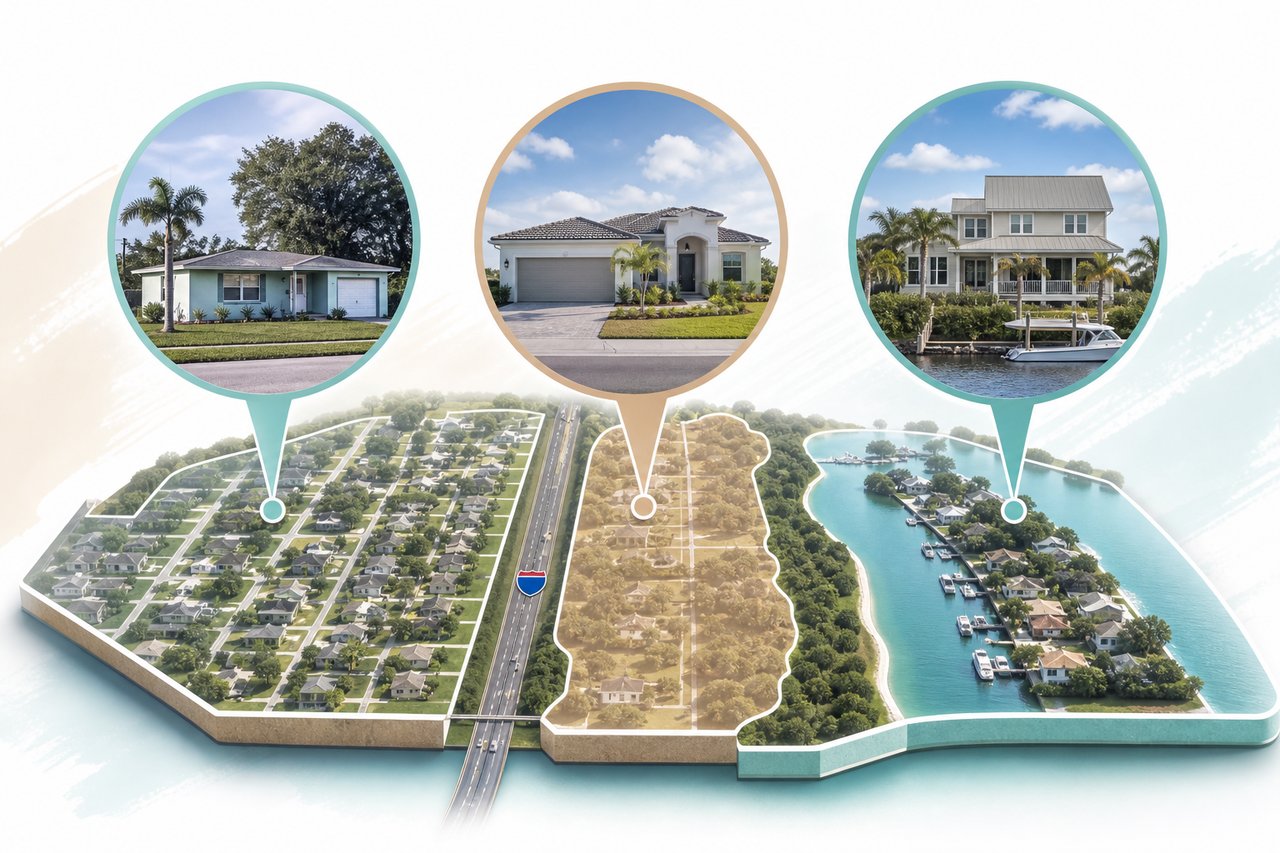
Port St. John Florida homes for sale fall into three distinct buying zones: a non-HOA core grid west of I-95, deed-restricted communities like Cypress Woods and Hundred Acre Woods east of I-95, and waterfront Riverside lots along the Indian River. Median sale prices range from $320,000 to $354,000 depending on the source and time period, and homes have been closing in a median of 22.0 days, which means neighborhood choice is the critical first step before you ever open a search portal.
Most listing sites treat Port St. John as one undifferentiated market. They show you a ZIP code, not a map of meaningfully different sub-markets with different HOA rules, flood profiles, lot sizes, and commute patterns. This guide breaks those zones apart so you can filter by what actually matters before you schedule a showing.
Port St. John is an unincorporated Brevard County community, not a city, so there is no city government, no city millage rate, and no municipal services separate from the county. Your taxes go to Brevard County, code enforcement runs through the county, and you pay no city millage on top of the county rate. The three zones covered in this guide behave differently enough that choosing the wrong one can mean the wrong flood profile, the wrong school cluster, or ongoing HOA costs you did not plan for.
Port St. John sits on Florida's Space Coast as an unincorporated Brevard County community, which means no city government, no city millage rate, and no municipal services separate from the county. That structure keeps your overall tax exposure lower than in incorporated Brevard cities and gives county code enforcement, not a city department, jurisdiction over your property.
One thing to clear up immediately: Port St. John is in Brevard County, on Florida's Space Coast. It is not part of St. Johns County, which sits near Jacksonville on the northeast coast. The two names confuse many out-of-state buyers researching online.
The population sits at 24,617, and the median household income is $84,214. That income profile reflects the community's ties to the aerospace and defense economy. Kennedy Space Center is about 12 miles to the southeast, and many residents work there or at one of the contractor campuses nearby.
Geographically, Port St. John runs along the western bank of the Indian River. That lagoon gives residents boat ramp access and waterfront recreation without the barrier island price premium you find in Cocoa Beach or Satellite Beach. Buyers who want water access but cannot absorb waterfront pricing often look here before anywhere else on the Space Coast.
Port St. John offers larger lots, lower overall tax exposure compared to incorporated Brevard cities, and a quieter residential character that suits buyers who prioritize space over walkability.
Port St. John's three zones, the non-HOA Core Grid west of I-95, the newer subdivisions east of I-95, and the waterfront Riverside Corridor along the Indian River, each carry a different HOA profile, flood exposure, and price point. Here is how they compare:
Zone | Location | Typical Property Type | HOA | Waterfront Access |
|---|---|---|---|---|
Core Grid | West of I-95 | Single-family, older builds | None | No |
East of I-95 Subdivisions | East of I-95 | Newer single-family, some planned communities | Some (Cypress Woods, Hundred Acre Woods) | No |
Riverside Corridor | Along Indian River | Single-family, larger lots | Rare | Yes (Indian River) |
Core Grid (West of I-95). This is the original Port St. John neighborhood, laid out in a straightforward street grid. Homes here are generally older, built from the 1960s through the 1980s, on lots that tend to run a standard 80 by 125 feet or larger. There are no HOA fees and no deed restrictions beyond county zoning. You can park a boat in your driveway, run a home-based business within county rules, or add a shed without asking a homeowners association for permission. The trade-off is that neighboring properties have the same freedom, so the visual consistency you get in a planned community is not guaranteed here.
Flood zone exposure varies by street in this zone. Some blocks sit in FEMA Zone X, which carries no mandatory flood insurance requirement. Others fall into AE zones closer to drainage channels. You need to check the specific parcel, not just the general neighborhood.
East of I-95 Subdivisions. The newer construction in Port St. John sits east of I-95, in subdivisions that were platted from the 1990s onward. Streets here are curvilinear rather than grid-based, lots are often slightly smaller, and some communities carry HOA covenants. Cypress Woods and Hundred Acre Woods are the two most recognized deed-restricted communities in this zone. Homes tend to be newer, with updated floor plans and, in some cases, community amenities.
Riverside Corridor. A narrower band of properties runs along the Indian River on the eastern edge of Port St. John. Lots here are larger and irregular, shaped by the waterway. Direct river access, a private dock, or a deeded boat slip is the primary draw. HOAs are uncommon in this corridor, but waterfront properties carry higher flood insurance exposure and typically sit in AE or VE flood zones. Buyers focused on boating or fishing often prioritize this zone regardless of the price premium over the core grid.
For a broader look at how Port St. John fits among other Space Coast communities, the Space Coast neighborhood guides cover the full range of Brevard County buying options, including Merritt Island homes for sale just to the south.
Port St. John splits cleanly between HOA and non-HOA territory: the Core Grid west of I-95 has no association fees or deed restrictions, while Cypress Woods and Hundred Acre Woods east of I-95 carry covenants that govern exterior appearance and property use. That choice affects your monthly costs, what you can store on your property, and how consistent the surrounding streetscape will look.
The non-HOA core grid gives you freedom that is rare in newer Florida communities. No monthly or annual association fees, no architectural review board, no rules about fence height or exterior paint colors. If you own a boat, an RV, or a work truck, you can keep it on your property without filing a variance request. Investors buying rental properties often favor this zone for the same reason: fewer restrictions on tenant use and property modifications.
The flip side is predictability. In a non-HOA neighborhood, the house next door can look however the owner chooses, within county code. That matters to some buyers and not at all to others. Be honest with yourself about which camp you are in before you fall in love with a specific address.
Cypress Woods and Hundred Acre Woods are the two deed-restricted communities most buyers encounter when searching east of I-95. Both carry HOA covenants that govern exterior appearance, lawn maintenance standards, and what you can store on your property. The practical effect is a more uniform streetscape and, for many buyers, a stronger sense of neighborhood cohesion.
HOA fees in these communities are generally modest compared to resort-style developments elsewhere in Brevard County, but verify the current annual or monthly figure directly with the association before closing. Fees can change, and the estoppel letter you receive during the contract period will show any outstanding assessments as well.
For the 2022 tax year, the millage rate for the unincorporated Port St. John area was 12.4551. That rate applies to the unincorporated zone broadly. It does not automatically apply to incorporated Brevard municipalities, and individual HOA sub-areas may carry additional assessments. The property tax section below walks through how to calculate a specific parcel's bill.
Buyers with school-age children sometimes use the HOA boundary as a proxy for school quality, assuming newer subdivisions mean better school assignments. That assumption is unreliable in Port St. John. School zoning runs by street address, not by subdivision or HOA status. The school confirmation step later in this guide covers how to verify the exact cluster for any parcel you are considering.
The honest summary: if you value flexibility, lower ongoing costs, and the ability to use your property without asking permission, the non-HOA core grid fits. If you want a more consistent neighborhood appearance and are comfortable with deed restrictions, Cypress Woods or Hundred Acre Woods are worth a close look.
Port St. John's median sale price sits somewhere between $320,000 and $354,000 depending on the source and the time period you reference. Real estate data for August 2026 puts the median at $320,000, while Movoto's numbers from March 2025 show $354,000. These are different snapshots, not a contradiction. Treat the range as a reasonable working frame rather than a single authoritative figure.
Momentum Realty's 2026 data shows homes closing in a median of 22.0 days. That is fast enough that waiting to get your financing in order before you identify a target neighborhood is a real risk. Buyers who arrive pre-approved and have already narrowed their zone preferences are the ones who move quickly enough to compete.
A 22-day median tells you that well-priced homes in Port St. John are not sitting. You are unlikely to negotiate a seller down significantly on a home that just hit the market at a fair price. Your leverage tends to come from inspection findings, not from waiting out a seller.
Price variation across the three zones is real but hard to pin to a single figure without knowing the specific street and condition. Riverside Corridor properties carry a premium over the core grid because of water access. East of I-95 subdivisions with newer construction often price above comparable square footage in the older core grid. The HOA vs. non-HOA distinction adds another layer: deed-restricted communities sometimes command a modest premium for the more consistent streetscape, though that gap narrows when you factor in ongoing HOA costs.
The core grid remains the most accessible entry point by price in Port St. John. If your budget is closer to the lower end of the range, that is where to focus your search first.
Property taxes in Port St. John are calculated against the unincorporated Brevard County millage rate, which for the 2022 tax year was 12.4551. That rate applies to the unincorporated Port St. John area specifically. It does not apply to incorporated Brevard municipalities, and you should not assume it covers any additional HOA assessments a specific community may carry.
Here is how to estimate the annual tax bill on a parcel you are considering:
Two things to keep in mind. First, the taxable value shown for the current owner may reflect a homestead exemption and Save Our Homes cap that resets when the property sells. Your taxable value in year one will be based on the purchase price, not the prior owner's capped figure. Second, if you establish Florida primary residency, you can apply for a homestead exemption that reduces your taxable value. The Florida Homestead Exemption guide for Space Coast homeowners walks through exactly how that process works and what it saves you.
Always verify the current millage rate directly with the Brevard County Property Appraiser before closing, since rates can change year to year.
School zoning in Port St. John runs by street address, not by subdivision name or HOA boundary. Two homes on opposite sides of the same street can feed into different school clusters. Assuming a neighborhood's reputation translates to a specific parcel's school assignment is a mistake that is easy to avoid and costly to discover after closing.
Brevard Public Schools provides the BPS School Locator tool to confirm the exact school assignment for any address in the district. Per maxliferealty.com and cocoabeachinsider.com, school zones in North Brevard can change or overlap, which makes address-level verification essential rather than optional. The tool runs in a browser at no cost.
Follow these two steps before you submit an offer:
Do this for every property on your shortlist, not just the one you are ready to offer on. Zone boundaries shift, and a street you toured six months ago may feed into a different school than you remember. Confirming the assignment in writing, or taking a screenshot of the locator result, gives you documentation you can reference if a question comes up during the transaction.
Use this checklist to match your priorities to the right zone before you start scheduling showings.
You want no HOA and maximum property flexibility:
Focus on the Core Grid west of I-95. You can park a boat or RV on your property, modify the exterior without approval, and avoid monthly association fees entirely.
You want a newer home with a more consistent neighborhood appearance:
Look at Cypress Woods or Hundred Acre Woods east of I-95. Both carry deed restrictions that produce a more uniform streetscape, and homes here tend to have more current floor plans.
Your priority is Indian River access for boating or fishing:
The Riverside Corridor is your zone. Budget for higher flood insurance exposure and expect to pay a premium over comparable square footage in the core grid.
You are working near the lower end of the $320,000 to $354,000 price range:
Start with the Core Grid. Older builds on standard lots represent the most accessible entry point in Port St. John by price.
Kennedy Space Center commute is a deciding factor:
All three zones offer a roughly 12-mile drive southeast to KSC. Zone choice does not meaningfully change commute time within Port St. John.
School zoning matters to your household:
Do not use subdivision name or HOA status as a proxy. Verify the exact school cluster for the specific parcel address using the BPS School Locator before you make an offer.
You want to compare Port St. John against other Brevard County options:
The Space Coast community guides map the full range of buying options across the county so you can see where Port St. John fits relative to Melbourne, Viera, and other communities.
Homes in Port St. John are closing in a median of 22.0 days. That pace leaves little room for the neighborhood research this guide covers once you are already under contract pressure. Buyers who arrive knowing their preferred zone, their HOA preference, and their school zoning requirements move faster and make fewer reactive decisions.
Jeremy Silber Real Estate is a Space Coast real estate agency where you can search active listings by neighborhood, request a home valuation, and connect directly with Jeremy to buy, sell, or rent across Brevard County communities including Port St. John. A local agent who knows the difference between a Core Grid parcel in an AE flood zone and a Riverside lot with a deeded slip is not a convenience. In a 22.0-day median market, that knowledge is what keeps you from making an offer on the wrong property.
A local agent flags flood zone exposure before you fall in love with an address, identifies whether an HOA estoppel shows deferred assessments, and tells you when a list price reflects a recent comp versus a seller's wishful thinking. Zillow and Redfin show you the listing. They do not show you what that listing actually means in this specific sub-market.
When you are ready to move from research to active search, start by identifying your zone from the checklist above, confirm your school zoning requirements, and get your financing in order before you schedule the first showing. In a market this fast, preparation is the advantage.
Prices and plan limits verified as of October 2026.
Port St. John is in Brevard County, on Florida's Space Coast, roughly 12 miles northwest of Kennedy Space Center. It has no connection to St. Johns County, which sits near Jacksonville on Florida's northeast coast. The names confuse many out-of-state buyers searching online. If you are looking at homes in the Port St. John area, you are in Brevard County, not St. Johns County.
Yes. Florida's homestead exemption is available to any buyer who establishes Port St. John as their primary residence. The exemption reduces your taxable value, which lowers your annual tax bill. It also activates the Save Our Homes cap, which limits how much your assessed value can increase each year. The Florida Homestead Exemption guide for Space Coast homeowners walks through the full process and what it saves you.
Waterfront homes in the Riverside Corridor do appear at lower price points, but inventory there is limited and moves quickly given Port St. John's 22.0-day median closing time. Lot size, dock access, and flood zone classification all affect pricing within the corridor. Set up a saved search filtered to the Riverside area and act on new listings promptly rather than waiting for the right one to sit.
Kennedy Space Center is approximately 12 miles southeast of Port St. John. Under normal traffic conditions, the drive runs roughly 20 to 25 minutes via State Road 528. All three Port St. John zones sit at a similar distance from KSC, so your zone choice within the community does not meaningfully change your commute time.
New construction in Port St. John is limited compared to faster-growing Brevard communities like Viera or West Melbourne. Most new builds concentrate east of I-95, where undeveloped lots remain. If new construction is a firm requirement, you may find more options by widening your search to nearby communities. The best neighborhoods in Brevard County guide covers a range of Brevard County communities where you can compare options beyond Port St. John.
Port St. John gives you three meaningfully different buying zones in a single ZIP code. The non-HOA Core Grid west of I-95 offers flexibility and the lowest entry price. The east of I-95 subdivisions, including Cypress Woods and Hundred Acre Woods, offer newer construction with deed restrictions. The Riverside Corridor trades a price premium for Indian River access. Median prices range from $320,000 to $354,000, and homes close in a median of 22.0 days. Knowing your zone before you search is not optional.
Before you schedule your first showing, confirm your flood zone tolerance for the specific parcel, verify school zoning through the BPS School Locator, and run a property tax estimate using the Brevard County Property Appraiser. Those three steps take less than an hour and will keep you from discovering a deal-breaker after you are already emotionally invested in an address.
Stay up to date on the latest real estate trends.
first time buyer
Discover 7 affordable homes on the beach for first-time buyers, with real price ranges, flood insurance costs, and market insights for 2025 and 2026.
Florida homes for sale
Find land for sale Brevard County FL with this guide covering prices, best areas, zoning, flood zones, and utility access for lots and acreage.
house for sale
Port St. John Florida homes for sale fall into three distinct buying zones: a non-HOA core grid west of I-95, deed-restricted communities like Cypress Woods and Hundre… Read more
Blue Origin
5 Space Coast Areas to Consider When Relocating for an Aerospace Job

Receiving a cash offer on your Brevard County home feels like the finish line moved closer overnight. No lender, no appraisal contingency, no waiting on underwriting. … Read more
Brevard County Real Estate
Satellite Beach sits on a narrow strip of land between the Atlantic Ocean and the Indian River Lagoon. That geography isn't a backdrop — it's the transaction. Every ho… Read more
West Viera Real Estate
West Viera homes for sale attract buyers who want newer construction, top-rated schools, and a master-planned community that actually delivers on its promises. Most li… Read more
West Melbourne Real Estate
West Melbourne sits in a part of Brevard County that buyers often overlook — and that's exactly why it keeps attracting the ones who do their homework. It shares a zip… Read more

buying a home
Florida gives homeowners a meaningful property tax break the moment they make the state their primary residence. Most people know the exemption exists. Far fewer know … Read more
Get assistance in determining current property value, crafting a competitive offer, writing and negotiating a contract, and much more. Contact Jeremy today so he can guide you through the buying and selling process.
LET'S WORK TOGETHER
JEREMY SILBER
3155 Suntree Blvd #101 Rockledge FL 32955