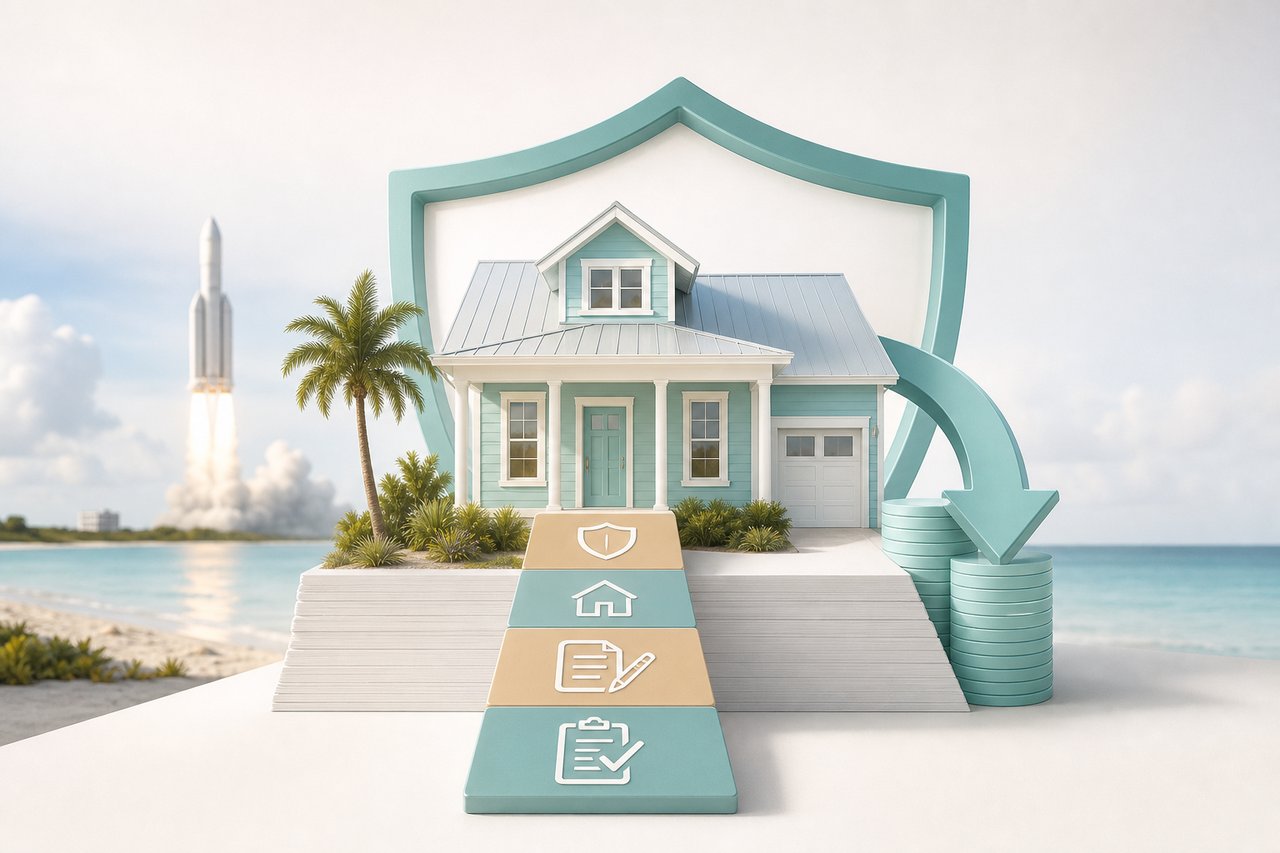
How the Florida Homestead Exemption Works: A Step-by-Step Guide for New Space Coast Homeowners
Florida gives homeowners a meaningful property tax break the moment they make the state their primary residence. Most people know the exemption exists. Far fewer know how to claim it, what it actually covers, or what happens if they miss the deadline.
If you recently bought a home in Melbourne, Viera, Cocoa Beach, Palm Bay, or anywhere else in Brevard County, this guide walks you through the entire process — the deadlines, the documents, and the protections that go well beyond the tax savings.
The exemption does two separate things. Most buyers only think about one of them.
First, it reduces your assessed value. Florida law lets you subtract up to $50,000 from your home's assessed value for property tax purposes. The first $25,000 applies to all taxing authorities, including your school district. The second $25,000 applies to everything except the school district.
In practical terms: if your home is assessed at $400,000, homestead brings that taxable value down to $350,000 for most purposes and $375,000 for school taxes. On a typical Brevard County millage rate, that saves most homeowners somewhere between $700 and $1,200 per year, depending on which taxing districts apply to your address.
Second, it activates the Save Our Homes cap. This is the part people underestimate. Once you have homestead status, Florida law limits how much your assessed value can increase each year — regardless of what the market does. The cap is 3% or the Consumer Price Index, whichever is lower.
In a hot market, that cap is worth thousands of dollars annually. It's also why long-time Florida homeowners sometimes pay dramatically less in property taxes than neighbors who bought recently.
The rules are straightforward, but you need to meet all of them.
You must own the property as of January 1 of the tax year you're applying for.
The property must be your permanent primary residence as of January 1.
You must be a Florida resident. If you're still maintaining a primary residence in another state, you don't qualify.
You can only hold one homestead exemption in Florida — and you can't hold one in another state at the same time.
That last point matters if you're relocating from New York, New Jersey, or any state with its own property tax exemption. You'll need to formally abandon that out-of-state exemption before or when you apply here.
Worth knowing: non-citizens can still qualify, as long as you hold a valid permanent resident card and the property is your primary residence.
March 1. That's the annual filing deadline for the Florida homestead exemption.
Close on a home in Brevard County on January 15, 2026, and you have until March 1, 2026 to file and receive the exemption for that tax year. Close on February 28 and you still make the window — but that's cutting it dangerously close.
Miss March 1 and you wait a full year. There's no late filing provision for standard homestead. The exemption won't apply until the following January 1.
One exception: if you miss the deadline due to a qualifying extenuating circumstance, you can petition the Value Adjustment Board (VAB) in Brevard County. These petitions are evaluated case by case and are not guaranteed. Don't count on it.
Step 1: Confirm Your Eligibility Date
Make sure you owned and occupied the property as your primary residence on January 1. Close on December 28 and you're eligible for that tax year. Close on January 3 and you're eligible starting the following year.
Step 2: Gather Your Documents
The Brevard County Property Appraiser's office requires:
Florida driver's license or ID card showing your new address
Florida vehicle registration showing your new address
Social Security numbers for all owners and their spouses
Your deed or closing documents showing ownership
Voter registration updated to your Brevard County address (required if you're a registered voter)
If applicable: permanent resident card or documentation for any co-owners
You don't need every item on day one, but you do need to demonstrate that Florida is your primary state of residency. The more documentation you provide upfront, the smoother the process.
Step 3: Update Your Florida Records First
Before you file, update your driver's license and vehicle registration to your new Brevard County address. The Property Appraiser's office cross-references these records. If your license still shows a New York or Georgia address, your application will be flagged.
The Florida DMV allows address updates online. Vehicle registration updates go through the DMV or a local tax collector's office. In Brevard County, the Tax Collector has offices in Melbourne, Cocoa, Titusville, and Palm Bay.
Step 4: File Online or In Person
The Brevard County Property Appraiser's office accepts online filings through their official website. You can also file in person at their Melbourne or Titusville offices.
Online is faster. You can upload supporting documents directly, and most applicants with their paperwork in order finish in under 20 minutes.
Step 5: Confirm Your Exemption
After you file, the Property Appraiser's office reviews your application and either approves it or requests additional documentation. A confirmation notice will come by mail.
Double-check your property record on the Brevard County Property Appraiser's website. Once approved, the exemption shows as "HX" on your property record.
Homestead is the foundation. Several other exemptions can reduce your taxable value further — and they're worth knowing if any apply to your situation.
Senior Exemption: Homeowners 65 and older with household income below a certain threshold may qualify for an additional $50,000 exemption on county taxes. Brevard County participates in this program.
Disability Exemption: Florida offers additional exemptions for homeowners with total and permanent disabilities, including a full exemption for certain qualifying veterans.
Veteran Exemptions: Combat-disabled veterans may qualify for a property tax discount proportional to their disability rating. Surviving spouses of veterans killed in action may qualify for a full exemption.
Widow/Widower Exemption: An additional $500 exemption is available to widows and widowers who have not remarried.
Each of these is filed separately and has its own documentation requirements. The Brevard County Property Appraiser's office can tell you which ones apply to your household.
If you're relocating from another Florida property where you had homestead status, you may be able to transfer your accumulated Save Our Homes benefit to your new home. This is called portability.
Here's why it matters. If your previous Florida home had a market value of $500,000 but an assessed value of $350,000 due to years of Save Our Homes caps, you have $150,000 in portable benefit. You can apply up to $500,000 of that difference to your new home's assessed value.
Portability doesn't transfer automatically. You must file a Portability Application (Form DR-501T) alongside your homestead application. Same deadline: March 1.
Coming to the Space Coast from out of state? Portability doesn't apply. But if you're moving from Tampa, Orlando, or anywhere else in Florida, calculate your potential savings before you file.
When you sell a homesteaded property, your Save Our Homes benefit doesn't transfer to the buyer. The buyer's assessed value resets to market value.
This is why you'll sometimes see a significant property tax jump after a sale in Brevard County. The previous owner had years of capped assessments. The new owner starts from scratch.
If you're buying in a neighborhood like Viera or Suntree where homes have been owned for a decade or more, ask your agent to pull the current assessed value versus market value. A large gap between those two numbers means taxes will likely increase after you close. That's part of the math you need to run before you make an offer.
This is separate from the property tax benefit, but worth knowing. Florida's homestead law also protects your primary residence from forced sale by most creditors — one reason Florida attracts people with significant assets or business exposure.
The protection applies regardless of the property's value, with some acreage limitations for rural properties. For a standard residential home in Melbourne or Cocoa Beach, there's no value cap on the creditor protection.
This isn't a substitute for legal advice. But it's part of why establishing Florida residency matters beyond just the tax savings.
Waiting too long to update their records. Close in December, delay your license update until February, and you may not have everything in order before March 1. Update your records within 30 days of closing.
Assuming the exemption transfers automatically. It doesn't. Every new owner must file a new application. If you bought a home that had homestead status under the previous owner, that exemption is gone. You start over.
Forgetting about portability. If you owned a homesteaded property in Florida before, leaving portability on the table is leaving money behind.
Filing with an out-of-state address on their license. The Property Appraiser's office will deny or delay your application. Update your license first.
Not checking for additional exemptions. If you're a veteran, over 65, or have a disability, you may qualify for benefits beyond the standard $50,000. Most people don't ask.
Property taxes are one piece of the total cost of homeownership in Brevard County. Insurance is another — and it's a significant one. Flood zone designation, wind mitigation ratings, and proximity to the coast all affect what you'll pay.
If you're weighing different communities, the 2026 Space Coast Corridor Buyer's Guide breaks down the trade-offs between Cocoa Beach, Melbourne, Palm Bay, and the communities in between, including how costs vary by location.
For buyers relocating from the Northeast, the tax picture in Florida often looks dramatically different from what you're used to. No state income tax, plus the homestead exemption meaningfully reduces your property tax exposure. The comparison of Space Coast versus New York costs gives a fuller picture of what that shift looks like in dollar terms.
The Florida homestead exemption is not automatic. You have to file, you have to meet the January 1 ownership and residency requirement, and you have to do it before March 1. Miss that date and you wait a full year.
Update your Florida driver's license and vehicle registration as soon as you close. Gather your documents. File online with the Brevard County Property Appraiser before the deadline. Then check your property record to confirm the exemption is showing as approved.
If you're still in the process of buying on the Space Coast and want to understand how property taxes, insurance, and community fees affect your total monthly cost, jeremysilber.com is a good place to start that conversation.
When is the deadline to file for the Florida homestead exemption in Brevard County? March 1 of the tax year you're applying for. You must have owned and occupied the property as your primary residence as of January 1 of that same year. There is no late filing option for standard homestead applications.
Can I apply for homestead exemption online in Brevard County?
Yes. The Brevard County Property Appraiser's office offers online filing through their official website. You'll upload supporting documents — Florida driver's license, vehicle registration, Social Security information — and most applications take under 20 minutes if your documents are ready.
What is the Save Our Homes cap and why does it matter?
Once your property has homestead status, Florida law limits annual increases in your assessed value to 3% or the Consumer Price Index, whichever is lower. In a rising market, that cap can save you thousands of dollars per year compared to what you'd pay if your home were reassessed at full market value each year.
I just moved from New York and still have a STAR exemption there. Can I apply for Florida homestead?
You can apply, but you must abandon your New York exemption first. Florida homestead requires that Florida be your one and only state of primary residency. Holding exemptions in two states simultaneously isn't permitted and can result in back taxes and penalties.
What is portability and who qualifies for it?
Portability lets Florida homeowners transfer their accumulated Save Our Homes benefit from a previous Florida homesteaded property to a new one. If your old Florida home had a large gap between market value and assessed value, you can apply up to $500,000 of that difference to your new home's assessed value. File a Portability Application (Form DR-501T) by March 1 alongside your homestead application.
Does the homestead exemption apply to condos and townhomes, not just single-family homes?
Yes. The exemption applies to any property that serves as your permanent primary residence — condos, townhomes, and mobile homes on owned land included. The same eligibility rules and filing deadlines apply regardless of property type.
What happens to the homestead exemption when I sell my home?
It doesn't transfer to the buyer. When a homesteaded property sells, the assessed value resets to market value for the new owner, who must file their own homestead application. This reset is why property taxes often increase noticeably after a sale in Brevard County.
Stay up to date on the latest real estate trends.
buying a home
Florida gives homeowners a meaningful property tax break the moment they make the state their primary residence. Most people know the exemption exists. Far fewer know … Read more

Cocoa Beach

Cape Canaveral Real Estate
What buyers should know about Cape Canaveral home prices, condos, flood zones, insurance, waterfront living, Port Canaveral, and the local market before making an offe… Read more

Viera, Fl
A practical guide to using your rental year to explore Viera, understand ownership costs, and confidently choose where and when to buy.

real estate
Learn why Zillow estimates, incomplete property data, and missed local costs can cause Brevard County homebuyers to overpay.

real estate
Explore home prices, neighborhoods, insurance costs, buyer strategies, and coastal living in Indialantic’s competitive 2026 real estate market.

Viera, Fl

Brevard County
Brevard County
How Do Days On Market Vary by Neighborhood?
Get assistance in determining current property value, crafting a competitive offer, writing and negotiating a contract, and much more. Contact Jeremy today so he can guide you through the buying and selling process.
LET'S WORK TOGETHER

JEREMY SILBER
3155 Suntree Blvd #101 Rockledge FL 32955